How to make my own sourdough starter
Flour, water, a jar, and about a week of twice-daily feeds until it doubles on schedule.
- Time
- 20 min
- Difficulty
- medium
- Makes
- 1 active starter jar
- Steps
- 6 steps
Updated Sep 6, 2026
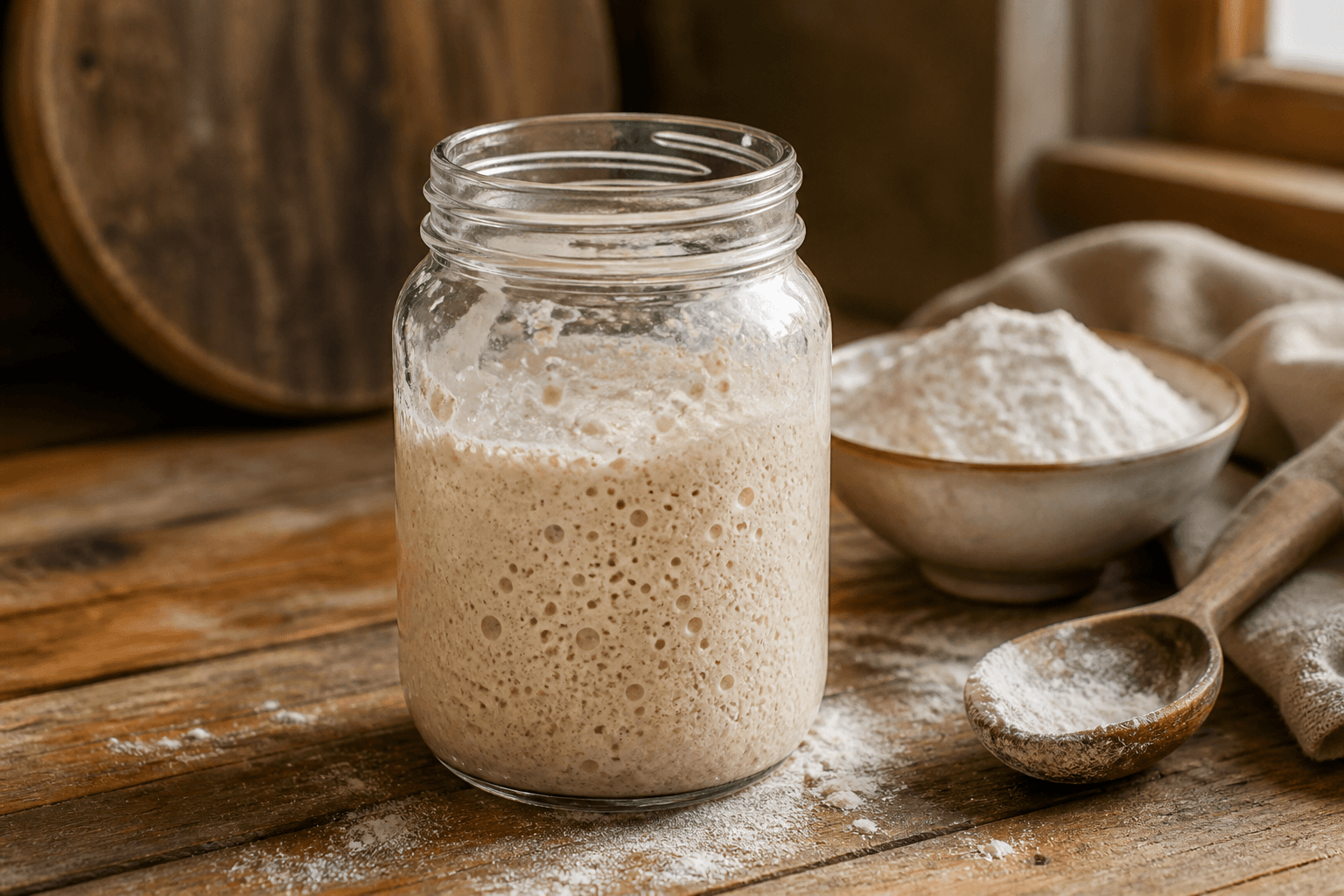
Starter is a wet flour culture you keep alive, not a packet of instant yeast. You are selecting wild yeast and bacteria that already live on grain and in your kitchen.
The only job for day one through seven is: mix, wait, discard, feed. Do not bake with it until it doubles in 4 to 8 hours after a feed and smells tangy, not like paint or vomit.
What you need
Step by step
- 01
Day 1, morning: mix 50 g whole-grain flour and 50 g water in the jar. Scrape the walls. Cover loosely. Leave at 22–26 °C if you can.
- 02
Day 2, morning: it may look sleepy. Stir, then add 50 g flour and 50 g water. Mark the height with the band.
- 03
Day 3 onward, morning and night: discard down to 50 g of the mixture. Feed 50 g white flour and 50 g water. Stir until no dry pockets remain.
- 04
If it hoists the band in 6 hours and is full of bubbles, you are close. If it never rises, the room is cold — move it to the oven with the light on, door cracked.
- 05
When it doubles predictably twice in a row, it is ready for a loaf. Use it at peak, not after it has collapsed.
- 06
For the fridge: feed, let it rise 1 hour, then cold-store. Feed at least once a week. Bring it out and give two room-temperature feeds before baking.
Email me the checklist
Checklist email is coming soon — use Print / save PDF for now, or check the materials list above.
Notes
- Pink, orange, or fuzzy growth is mold. Throw the jar contents out and start over. A dark hooch on top is hunger — pour it off and feed.
- Discard is still flour paste. Cook it as pancakes; do not pour pounds of it down a slow drain.
- Whole-grain at the start jump-starts activity. Switching to white later makes a milder, more predictable rise.
Questions people ask
Safety note: this is practical DIY guidance, not medical, chemical, or professional advice. Skip anything that feels unsafe for your setup.
Make something else
Craft
How to make my own
air dry clay trinket dish
Shape a small clay dish for rings and keys without a kiln, then paint and seal it so it lasts. Very little kit needed.
- Time
- 1 h
- Difficulty
- easy
- Makes
- 2 small dishes
Wellness
How to make my own
lip balm
Melt beeswax, shea butter and oil into smooth lip balm tubes in about half an hour, with the firmness and scent you choose.
- Time
- 35 min
- Difficulty
- easy
- Makes
- about 10 tubes
Craft
How to make my own
pressed flower bookmarks
Press real flowers flat in a book, then seal them onto card for bookmarks that keep their colour and don't shed petals.
- Time
- 45 min
- Difficulty
- easy
- Makes
- 4 to 6 bookmarks
Digital
How to make my own
qr code
Make a free QR code that never expires, prints crisply and scans first time on any phone, for a link, your Wi-Fi or a contact card.
- Time
- 20 min
- Difficulty
- easy
- Makes
- 1 QR code